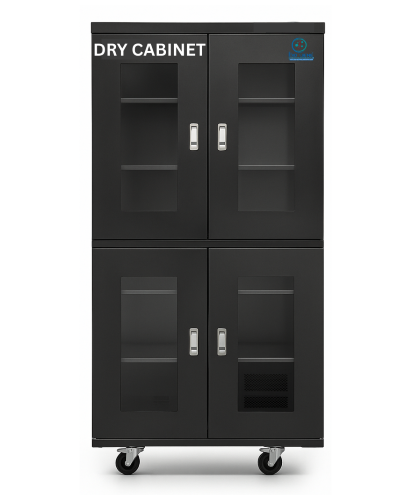
ESD Safe Dry Storage Cabinet Applications
ESD Safe Dry Storage Cabinets are designed to protect moisture-sensitive and static-sensitive components by maintaining controlled low-humidity conditions while reducing the risk of electrostatic discharge. They are widely used in electronics, semiconductor, aerospace, automotive, medical, and precision manufacturing environments.
- Electronics Component Storage: Safe storage of PCBs, ICs, resistors, capacitors, sensors, connectors, and other moisture-sensitive electronic components.
- PCB & SMT Components: Protects printed circuit boards and surface-mount devices from moisture absorption before assembly and soldering.
- Semiconductor Storage: Suitable for integrated circuits, semiconductor devices, wafers, and other sensitive components requiring controlled humidity.
- Aerospace & Defence Electronics: Used for storing sensitive avionics, electronic modules, sensors, and precision components.
- Automotive Electronics: Protects ECUs, automotive sensors, control modules, and electronic assemblies from humidity and static-related damage.
- Medical Electronics: Suitable for storing sensitive electronic components and assemblies used in medical equipment.
- Laboratory Applications: Used in R&D laboratories for moisture-sensitive samples, electronic components, sensors, and precision instruments.
- Battery & Energy Storage Components: Suitable for selected moisture-sensitive battery materials, electronic modules, and energy-storage components where low-humidity storage is required.
- Optical & Precision Components: Helps protect sensitive optical, mechanical, and precision components from moisture-related deterioration.
- Production & Assembly Areas: Provides controlled storage near production lines for components awaiting assembly or testing.
- ESD-Controlled Workplaces: Suitable for electronics manufacturing facilities, cleanrooms, laboratories, and other ESD-protected environments.
- Long-Term Component Storage: Helps minimize moisture exposure during extended storage and inventory management.
ESD Safe Dry Storage Cabinet Features
Intelligent Digital Controller
Microprocessor-based controller with real-time temperature and humidity monitoring, adjustable RH settings, and simple push-button operation.
Tempered Glass Viewing Door
Allows visual inspection of stored contents without opening the cabinet, with a secure locking handle.
Powder-Coated CRCA Steel Body
Durable, anti-static, industrial-grade construction built for long service life.
Adjustable Shelves
Reconfigurable shelf spacing to suit different component sizes, with up to 50 kg load capacity per shelf.
ESD-Safe Design
Minimizes electrostatic discharge risk during storage and handling of sensitive electronic components.
Secure Door Locking System
Ergonomic lock handle with two keys for restricted, safe access.
Quiet, Continuous Operation
Low-noise electronic dehumidification runs continuously without disrupting lab or production environments.
Available Accessories
- Additional Shelves
- ESD-Safe Castor Wheels
- Digital Data Logger
- ESD Accessories
- Customized Configurations
ESD Storage Cabinet Applications
Electronics Manufacturing
Semiconductor Industry
Pharmaceutical Industry
Medical Devices
Research Laboratories
Aerospace
Defence
Automotive
Quality Assurance
Every BioGene cabinet undergoes quality inspection and performance verification before dispatch. BioGene is SAMAR Certified Level 3 by the Quality Council of India, reflecting a high level of defence manufacturing maturity and process reliability.
ESD safe dry storage cabinet
Electronic dry cabinet
Dry storage cabinet for electronics
Humidity controlled storage cabinet
BioGene dry cabinet
Dehumidifier storage cabinet India
Dry cabinet for PCB storage
Anti-static dry storage cabinet
Moisture control cabinet for semiconductors
Dry storage cabinet for laboratory samples
Dry cabinet for medical devices
SAMAR certified dry cabinet manufacturer
98L / 220L / 300L / 540L / 850L / 1200L / 1428L dry cabinet
Low humidity storage cabinet manufacturer India
ESD safe cabinet for precision instruments
Dry cabinet for aerospace and defence components
Digital humidity controller dry cabinet
CRCA steel dry storage cabinet
Dry storage cabinet supplier Ghaziabad
Technical Specifications
BioGene ESD Safe Dry Storage Cabinet Model Comparison
| Model |
BTI-98L |
BTI-220L |
BTI-300L |
BTI-540L |
BTI-850L |
BTI-1200L |
BTI-1428L |
| Capacity (Litres) |
98 L |
220 L |
300 L |
540 L |
850 L |
1200 L |
1428 L |
| External Dimensions (W×D×H mm) |
450×400×710 |
600×450×970 |
600×450×1285 |
600×600×1650 |
900×600×1650 |
1200×600×1650 |
1200×710×1850 |
| Internal Dimensions (W×D×H mm) |
448×350×560 |
598×400×820 |
598×400×1130 |
598×550×1460 |
898×550×1460 |
1198×550×1460 |
1198×660×1660 |
| Net Weight (Approx.) |
25 kg |
40 kg |
50 kg |
70 kg |
95 kg |
125 kg |
150 kg |
| Standard Shelves |
1 |
2 |
2 |
3 |
3 |
4 |
4 |
| Power Consumption (Approx.) |
10 W |
15 W |
15 W |
20 W |
25 W |
30 W |
35 W |
Common Specifications (All Models)
| Shelf Load Capacity |
50 kg per shelf (uniformly distributed) |
| Humidity Range |
1% RH to 60% RH (Adjustable) |
| Humidity Control Accuracy |
±3% RH |
| Display Resolution |
0.1% RH |
| Controller |
Microprocessor-based digital controller with humidity display |
| Dehumidification System |
Electronic dehumidification with advanced moisture-sensing technology |
| Sensors |
High-precision digital humidity sensor |
| Door |
Tempered glass door with handle and lock |
| Cabinet Material |
CRCA steel with anti-static powder coating |
| ESD Safe |
Yes |
| Power Supply |
230V AC, 50Hz |
An ESD safe dry storage cabinet is a sealed enclosure designed to protect electrostatic sensitive devices from two major threats at once: static discharge and moisture damage. Standard storage cabinets may guard against dust or physical damage, but they do nothing to control humidity or static buildup. Components like semiconductors, PCBs, MEMS sensors, and BGA packages can absorb moisture from the air, which leads to problems such as popcorn cracking during reflow soldering. At the same time, static electricity can silently damage sensitive circuitry without any visible sign. This cabinet solves both problems simultaneously by maintaining a low humidity environment while also providing ESD protective construction to safely dissipate static charges.
Most ESD safe dry cabinets use nitrogen purging or a desiccant based drying system, sometimes paired with electronic dehumidification, to actively remove moisture from the sealed chamber. The cabinet continuously monitors internal humidity through a built in sensor and digital display, automatically adjusting to maintain the target range. Typical cabinets can maintain relative humidity anywhere from below 1% RH in high end nitrogen systems up to around 20 to 30% RH in standard desiccant models, depending on the model and settings you choose. For components governed by moisture sensitivity level standards such as J-STD-033, you will want to select a cabinet capable of reaching and holding the specific RH threshold required for your parts, usually under 5% RH for the most sensitive levels.
The key difference lies in the materials and grounding design. An ESD safe cabinet is constructed using static dissipative materials for the shelving, interior panels, and sometimes the exterior housing, with surface resistivity typically falling within the 10^6 to 10^9 ohm range. This allows any static charge to drain away gradually and safely rather than discharging suddenly, which could damage components. The cabinet also includes a proper grounding point or grounding strap connection so the entire unit can be tied to a common ground, and many models include ESD warning labels and color coded components, often in the familiar pink or black, to signal safe handling zones.
Generally, any component classified as moisture sensitive under J-STD-020 or J-STD-033, or any device labeled as electrostatic sensitive with ESD warning symbols on its packaging, should be stored in an ESD safe dry cabinet once its original moisture barrier bag has been opened or its floor life clock has started. This includes items like BGAs, QFNs, flip chips, MEMS devices, camera modules, and many surface mount components. If you are unsure whether a specific part requires this level of protection, checking the manufacturer's datasheet or the moisture sensitivity level rating printed on the original packaging will confirm whether dry and ESD safe storage is necessary.
Routine maintenance mainly involves checking the door seals for wear since a compromised gasket will let humidity leak in and reduce efficiency, monitoring or replacing desiccant cartridges if your model uses them, and periodically verifying that the humidity sensor readings match an external reference using a calibrated hygrometer. Most manufacturers recommend calibration checks every six to twelve months, though this can vary based on usage frequency and environmental conditions in your facility. It is also good practice to keep the grounding connection clean and secure, and to avoid overloading the cabinet since restricted airflow can create uneven humidity distribution inside the chamber.


 Related Products