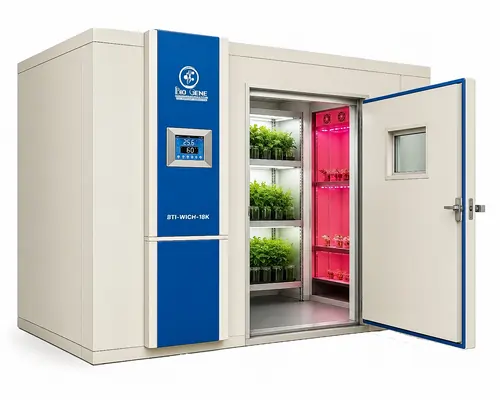
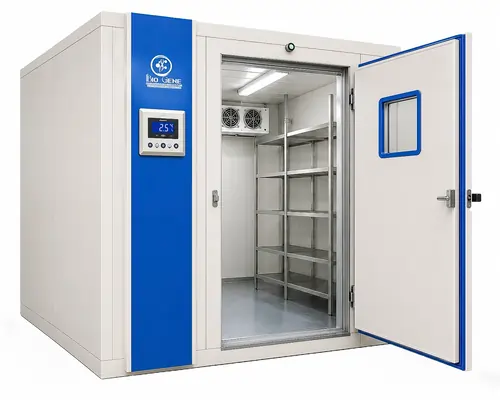
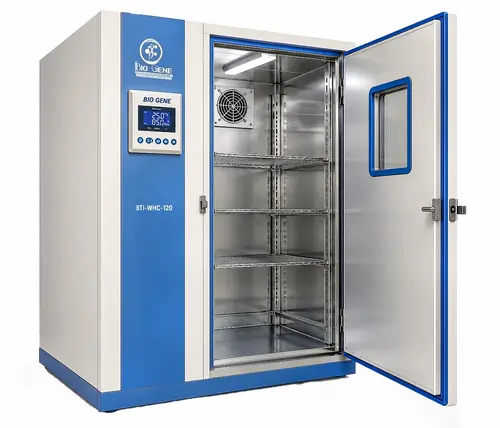
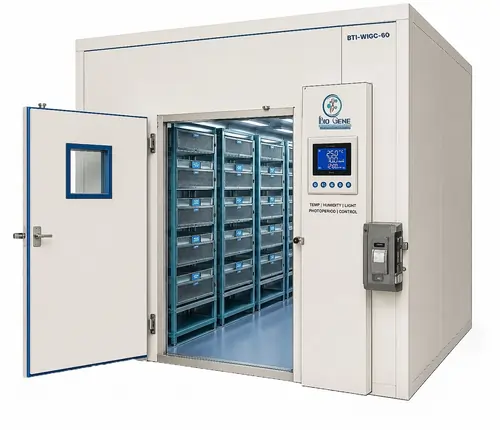
Applications
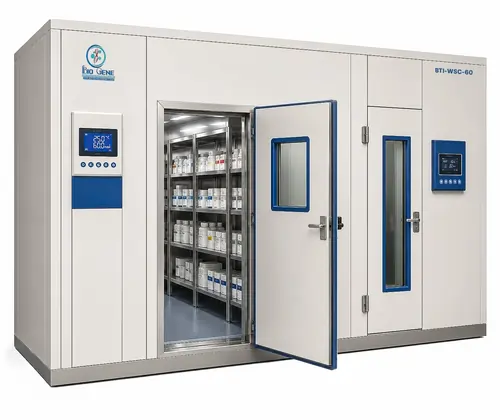
Walk in chamber’s allows the user to have an advantage in stability Environment test due to persuit of reliability in speedy test results in given time from work with reliable repeat performance of products for durability performance before the product market launch.
Feature
- Walk in Stability
- Large Touch Screen Control’s Display
- 21 CFR port 11 software
- Prefabricated PUF Panels
- CAM Hinge Locking Device
- French Compressor
- Data Transfer RS 485 or WiFi
- Temperature: -5˚C- 60˚C
Control
- Standards : ICH-Q1AR2
- ISO – 13485 Standards,
- EN 61000-6-3 : 2001
- EN: 60101
- IEC – 60068-2-1 COLD
- IEC – 60068-2-2 Dry Heat
- IEC – 60068-2-14 Temperature change
- IEC – 60068-2-38
Construction
- Prefabricated Panel with CAM locks
- Large 7”/9” LCD Display
- Touch Screen Controls
- Inner Stainless Steel or Polypropylene
- Forced Air Circulation
- French cooling unit
- Large Door
- Flexible Storage system
- Safety Alarm
Specification
| DESCRIPTION |
BTI-WSC-35 |
BTI- WSC-60 |
BTI- WSC-150 |
BTI- WSC-220 |
| Temperature Range on |
5°C to 60°C |
| Temperature Range Lights On |
5°C to 55°C. |
| display |
Digital |
| Temp. Deviation |
Between +1°C and +25°C @ 80% RH (lights off) |
| Temperature Uniformity |
+2°C at +25°C @ 80% RH (lights off) |
| Temperature Control |
+/- 0.1° c deg. |
| Temperature uniformity |
+2°C @ 25°C @ 80% RH (Lights off) |
| Temperature sensor |
PT-100 Ω RTD |
| Humidity range |
5% RH to 90% RH |
| Humidity deviation |
3% RH |
| Humidity uniformity |
+ 5% RH |
| Humidity control accuracy |
± 1% |
| Interior construction |
SS 304 |
| Exterior Construction |
CRCA Powder coated. |
| |
|
| Construction |
Panel Type PUFF Insulation for better thermal insulation. |
| Electrical |
220 to 240 volts/ 50 Hz. |
| Alarm |
High and low |
| Light Intensities |
@ 25 °C |
| Size |
1500 x 1500 x 1500 mm |
1500 x 2000 x 2000 mm |
2500 x 2500 x 2500 mm |
3500 x 2500 x 2500 mm |
| Capacity |
3500 ltrs |
6000 ltrs |
15600 ltrs |
22000 ltrs |
A Walk-In Stability Chamber is a large, room-sized environmental testing enclosure designed to hold products, pharmaceuticals, or materials under precisely controlled temperature and humidity conditions for extended periods. It is primarily used by pharmaceutical, biotechnology, food, and cosmetic companies to conduct long-term and accelerated stability studies as required by regulatory bodies such as ICH, WHO, and USFDA, helping determine shelf life, storage conditions, and product behavior over time.
Most walk-in stability chambers are designed to maintain temperatures typically ranging from 0°C to 60°C and relative humidity levels between 10% RH and 95% RH, depending on the specific model and manufacturer specifications. The exact range can be customized based on the client's testing requirements, such as standard ICH conditions of 25°C/60% RH, 30°C/65% RH, or 40°C/75% RH for accelerated studies.
Uniform temperature and humidity distribution is achieved through a combination of advanced airflow design, multiple sensors placed throughout the chamber, and precision PID or microprocessor-based controllers. Regular calibration of sensors, along with continuous monitoring systems, ensures that conditions remain accurate and consistent across all zones of the chamber, minimizing variation between different storage locations.
Walk-in stability chambers typically come equipped with safety features such as door safety locks that allow opening from inside, over-temperature protection, power failure alarms, and emergency ventilation systems. Additionally, they often include 21 CFR Part 11 compliant data logging software, real-time remote monitoring, audit trails, and alarm notifications via SMS or email to ensure continuous compliance and immediate response to any deviations.
Routine maintenance includes periodic calibration of sensors, cleaning of humidity generation systems, inspection of door seals and gaskets, and servicing of refrigeration or HVAC components to ensure long-term reliability. For regulatory compliance, chambers should undergo Installation Qualification, Operational Qualification, and Performance Qualification (IQ/OQ/PQ), along with regular mapping studies to confirm that temperature and humidity uniformity meet required standards throughout the chamber's operational life.

 Related Products