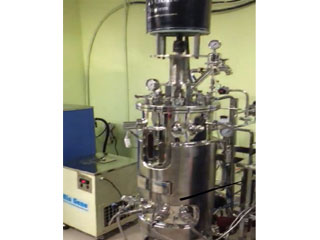
Glass Fermenters for Microbial Culture, Lab Research & Biotech Development

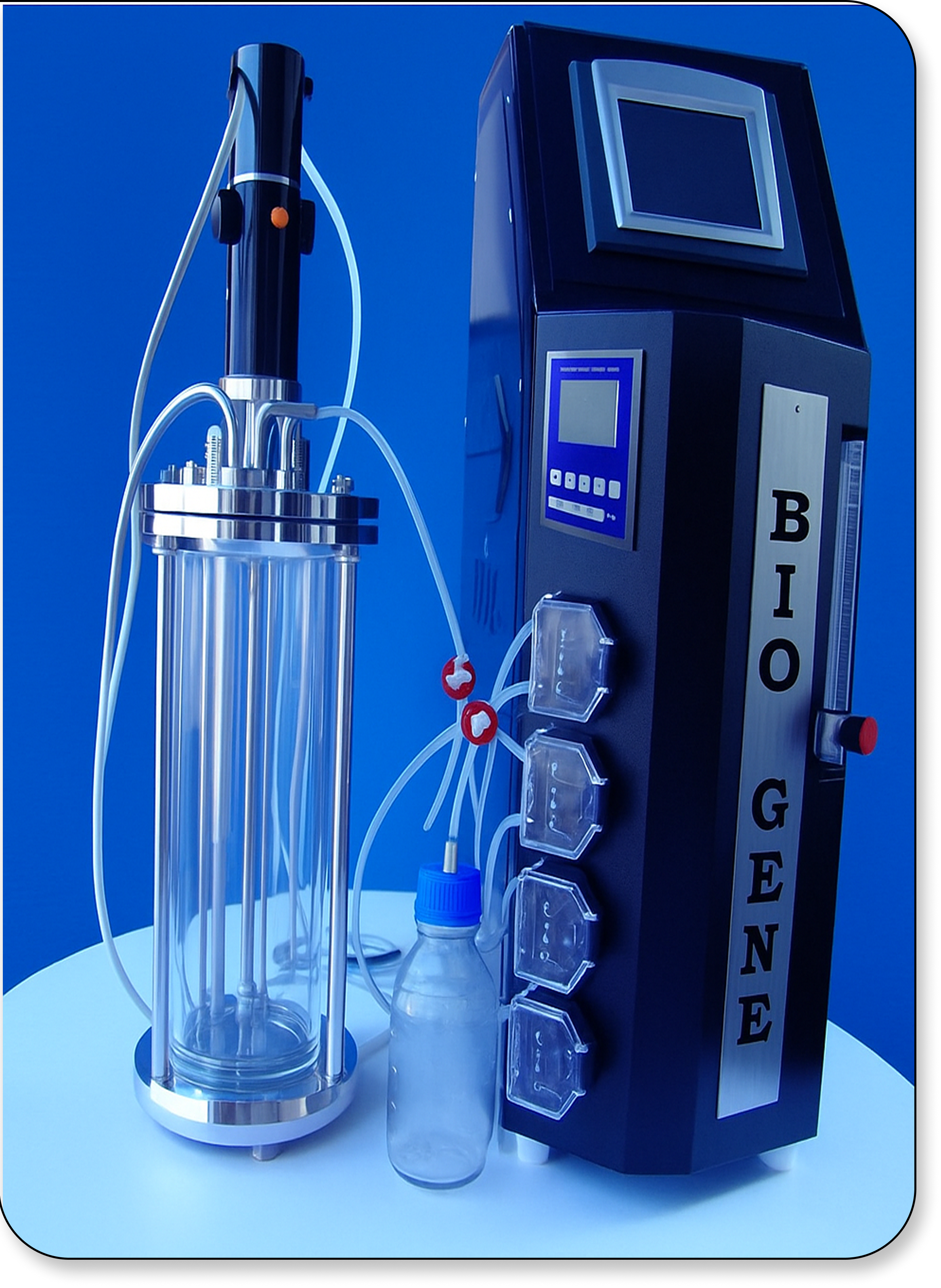
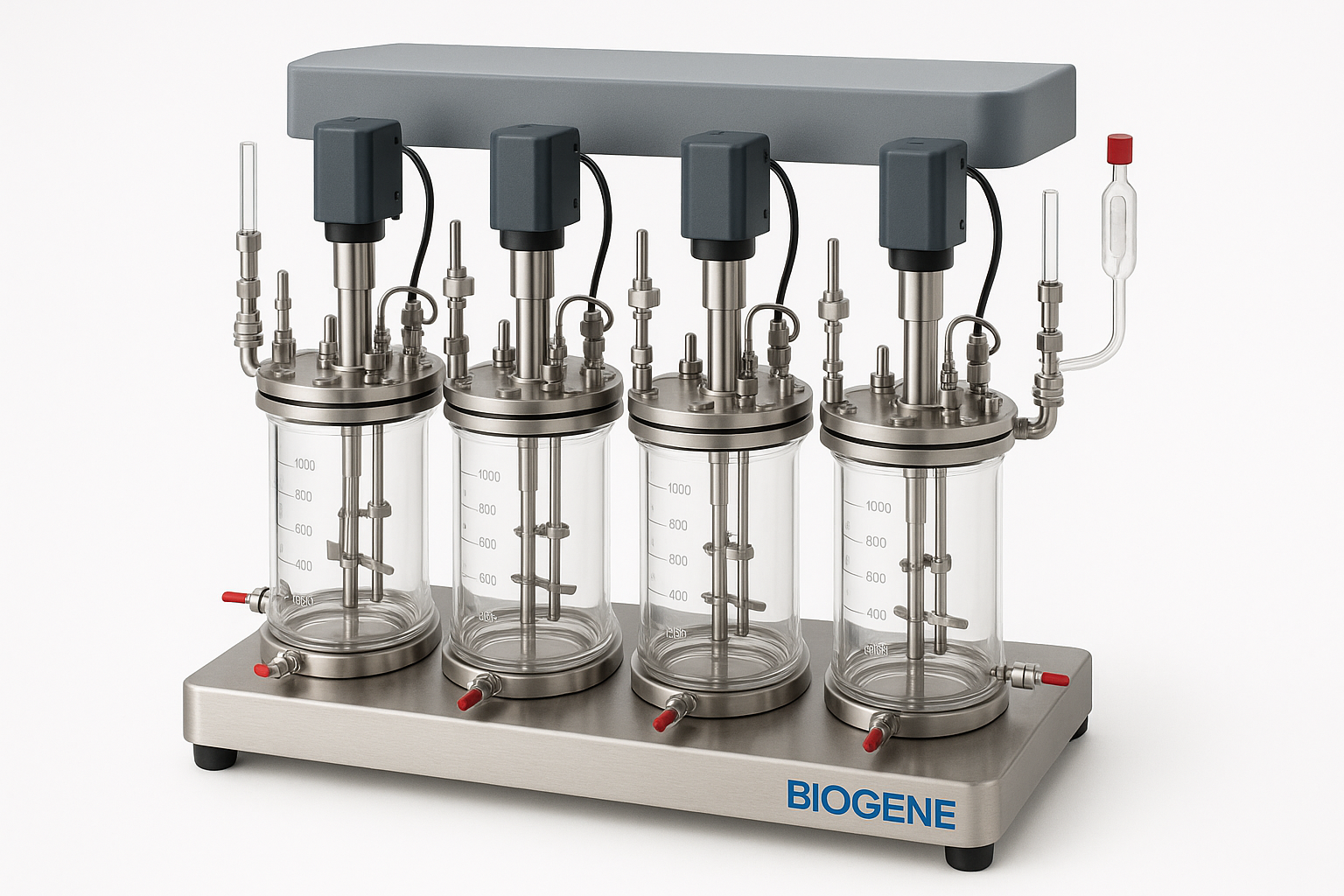
A Glass Fermenter is a versatile, transparent bioreactor designed for optimal visibility and precision control during microbial and cell culture processes. Its borosilicate glass vessel allows real-time observation of the fermentation process, making it ideal for research, teaching, and pilot-scale production.

Engineered for biotechnology, pharmaceuticals, food & beverage, and defense R&D, glass fermenters provide exceptional chemical resistance, precise parameter control, and compatibility with both aerobic and anaerobic cultures. These fermenters are available in benchtop and floor-standing models to suit small-scale to pilot-scale operations.

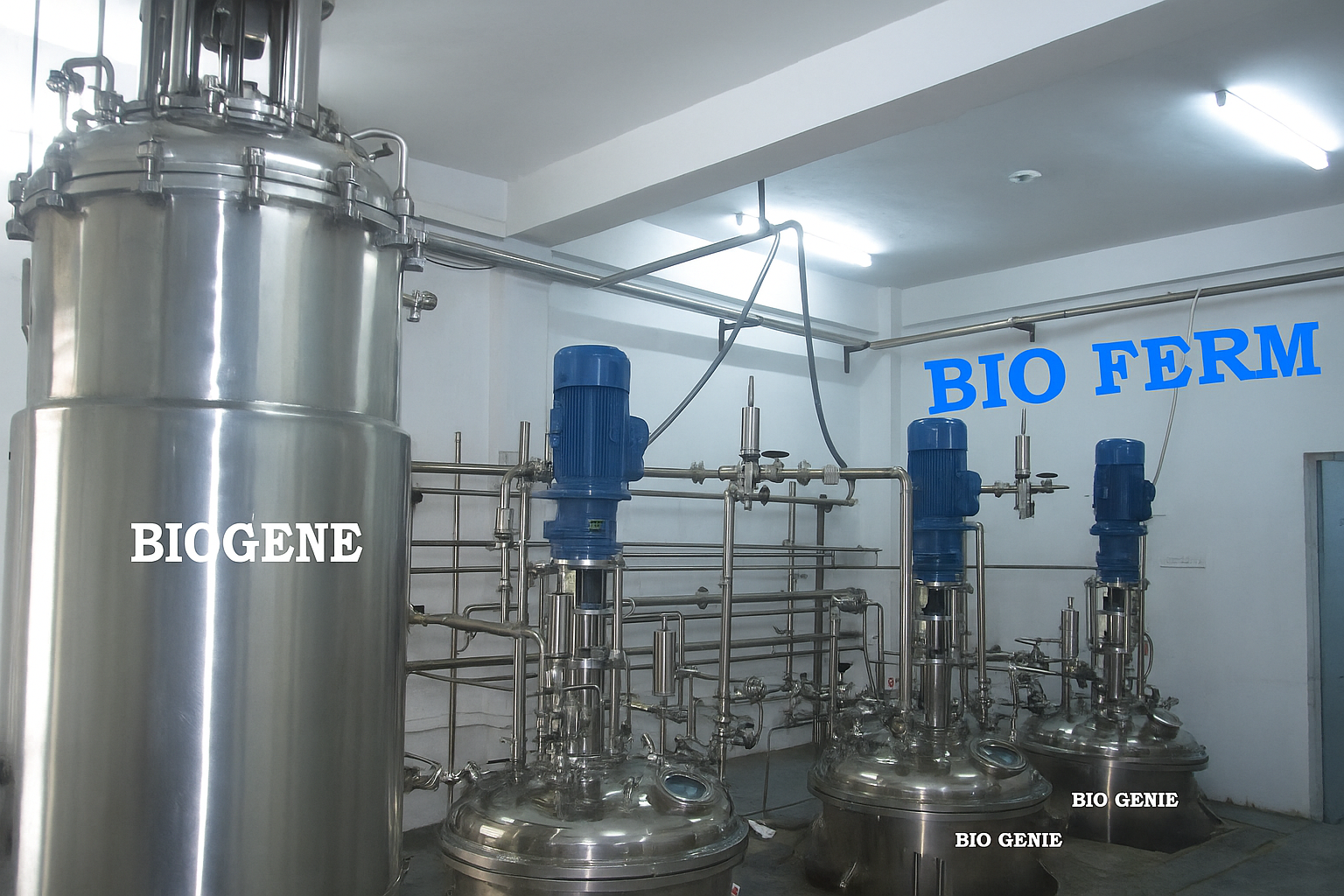
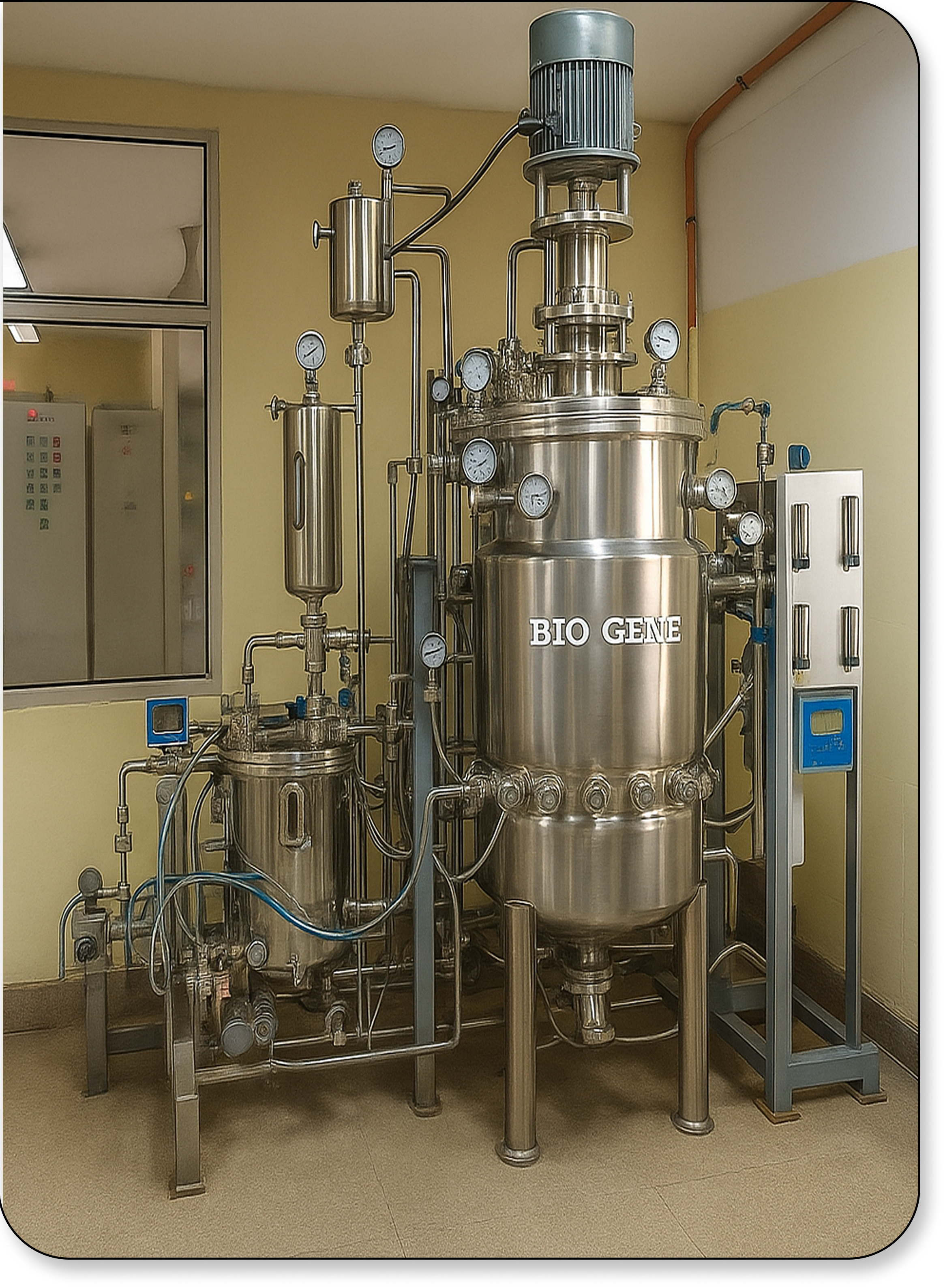
BioGene Glass Fermenters are laboratory-scale bioreactors designed for precision-controlled microbial and cell culture fermentation. Built with borosilicate glass vessels and stainless steel components, these fermenters offer full visibility, easy cleaning, and chemical resistance—ideal for R&D, process development, strain screening, and academic research. Manufactured and exported by Biotechnologies Inc., BioGene glass fermenters are available in various volumes with options for manual or automatic control systems, aeration, agitation, pH, DO, and temperature regulation. Proudly made in India and trusted globally, these fermenters ensure accurate, reproducible fermentation in research environments.

BioGene Fermenters for Growing Almost Any Cell Type

BioGene Fermenters are designed to support the cultivation of a wide range of cell types. With a variety of vessels, impellers, and customized configurations, our fermentation and bioreactor systems can accommodate different biological processes, including the cultivation of anaerobic and aerobic microbes, yeast, insect cells, and plant cells.

Microbial Cell Cultivation

Microbial cells generally have sturdy cell walls and may form clumps during cultivation. These cultures can tolerate more vigorous mixing conditions, often require substantial aeration, and may benefit from appropriately selected impellers that help disperse cell aggregates and promote efficient mixing.

Mammalian Cell Cultivation

Mammalian cells lack rigid cell walls and are often more fragile and sensitive to mechanical stress. Bioreactor vessels designed for mammalian cell cultivation can be equipped with impellers that provide gentle mixing while minimizing shear forces, helping maintain suitable conditions for cell growth.

Glass Fermenter Import and Export Services Worldwide

We provide reliable import and export services for Glass Fermenters to America (USA), Germany, Japan, China, Mexico, Vietnam, South Korea, Canada, the UK, France, Italy, Spain, the Netherlands, Australia, Russia, Kazakhstan, Pakistan, Bangladesh, the Philippines, Indonesia, Malaysia, Thailand, Singapore, Saudi Arabia, the UAE, South Africa, Turkey, Brazil, and Poland.

Our international export services include secure global shipping, export documentation, customs clearance assistance, and compliance support for biotechnology, pharmaceutical research, microbiology, fermentation studies, laboratories, and industrial research applications.

Request a Glass Fermenter Quote

Looking for a Glass Fermenter manufacturer, supplier, or exporter? Contact BioGene today for detailed product specifications, customized fermentation solutions, competitive pricing, and worldwide delivery options.

Send your inquiry today to request a quotation tailored to your technical requirements, application, vessel configuration, and destination country.

  • Temperature Control System
  • Microprocessor Based Automated Heat Exchanger
  • Automatic Agitation system
  • Automatic Exhaust System
  • The exhaust port on the Bio Gene fermenter is connected to atmosphere through Single Round 0.2 μ Sterilizable grade air filter and SS316L Housing.
  • Cooling Condenser is provided to condense escaping moisture.  
  • Automatic ASME Compliance Bio Gene design in accordance with ASME Code. Filter area is designed as per the optimal pressure drop requirements.
  • Automatic Aeration System
  • Bio Gene Bio ferm air inlet port(s) of the Fermenter is connected to the air line through a sterilizable grade 0.2 μ air filters. 
  • Automatic pH / ORP Control System 
  • Automatic Redox Monitoring and Control
  • Automatic Sampling System
  • Automatic Harvesting System
  • Automatic Nutrient Feed
  • Foam Control System 
  • Touch Screen Automation and Control
  • State of Art Control Cabinet 


  • Bio Gene uses state of Art Latest technology
  • Bio Gene BioDASCADA Software
  • Batch Recipe system, Batch creation & Initialization.
  • Display of all parameters of all reactors in the same page with pop-up set point window
  • Display of minute wise updates of all configured parameters, pH, DO, Flow, Pressure, Temp., RPM Error display and control page.
  • Bio Gene BioFerm SCADA Software 
  • Bio Gene controller with variable 8 process microprocessor based advance controller

Alarms & Signals

  • Culture medium temperature control (Range: 5 – 70oC; Precision  0.01oC)
  • Culture medium pH control
  • agitation rate control
  • Foam level control
  • Air Flow control
  • High/Low temperature audiovisual signal
  • High/Low pH audiovisual signal
  • High/Low-agitation rate audiovisual signal
  • High/Low-PO2 audiovisual signal
  • High/Low-Air flow rate audiovisual signal
  • High - Foam Audiovisual signal
  • Top Driven Magnetic Drive
  • Contamination free stirrer assembly with shaft
  • Gaskets / O-rings Silicon & EPDM
  • Height Adjustable 6 Blade Ruston Turbine-2 Nos., 
  • Baffles  4 Nos. Removable Type Material SS316L
  • The shaft is equipped with 3 No., 6 blade rushton turbine impeller with height adjustment facility and run on top driven agitator. Diameter of impeller is 0.40 times the inner diameter of the Fermenter. The agitator will include motor, agitator shaft with impellers, drive, mounting flange, variable frequency controller, Magnetic Drive/Double mechanical seal and driver support structure.
  • Baffles are also provided to break the vortex formation. Agitator will be suitable for the range of specified operations and ambient conditions and for variable speed operations controlled by an independent control loop.
  • MOC for the Impellers and shaft will be SS 316 L with a surface finish of Ra < 0.5 μ and fully electro polished. 
  • Bio Gene design in accordance with ASME Code. Filter area is designed as per the optimal pressure drop requirements.
  • The SS 316 L filter housings are provided with tri-clamp connections to allow removal of the housings. The Sparger in the fermenter is connected to Air line.
  • A pH sensor is provided on the fermenter for monitoring and controlling the pH of the contents of fermenter system. The Fermenter is provided with Peristaltic Pump for dosing acid and alkali stock solutions through food grade silicon tubing with autoclavable septum port assembly, responding to signal from online gel-filled pH sensor based on the pH set point. Addition of acid and alkali stock solutions achieves pH control in the fermenter.
  • Sampling system consists of a zero dead leg manual sampling valve with Unique sampling assembly with zero dead leg.
  • Peristaltic pumps (Positive displacement pump) are provided for nutrient feeding. Pumps can be controlled to feed nutrient based upon level based feeding, through automatic peristaltic pump feeding program module in SCADA and HMI.
  • The Fermenter is provided with a Peristaltic Pump for dosing antifoam solution into the Fermenter, responding to signal from conductivity based SS-316L electrode foam sensor. Also gives automatic alarm.
  • The Fermenter consists of a zero dead leg flush Bottom valve,  provided on the bottom dish of the Fermenter vessel. 
  • The exhaust port on the Bio Gene fermenter is connected to atmosphere through Single Round 0.2 μ Sterilizable grade air filter and SS316L Housing.
  • Cooling Condenser is provided to condense escaping moisture.  

We provide reliable import and export services for Pilot Scale Fermenters to the USA, Germany, Japan, China, Mexico, Vietnam, South Korea, Canada, the UK, France, Italy, Spain, the Netherlands, Australia, Russia, Kazakhstan, Pakistan, Bangladesh, the Philippines, Indonesia, Malaysia, Thailand, Singapore, Saudi Arabia, the UAE, South Africa, Turkey, Brazil, and Poland. Our global export solutions include secure international shipping, export documentation, customs clearance assistance, and compliance support for laboratory, biotechnology, pharmaceutical, microbiology, fermentation, and scientific research applications. We are committed to delivering dependable international logistics and professional export support to customers worldwide.

Gross Volume | Working Vol 2L to 10L
Type Autoclavable
Aspect Ratio 1:2
Design Guidance Vessel
Design Code ASME Section VIII Div. BPE 2009
Working pressure Full vacuum to 3 Kg/cm2
Design Pressure Full Vacuum to 3.5 Kg/cm2
Hydraulic Test Pressure Full Vacuum to 5.0 Kg/cm2
Working Temperature 10  to 140 deg. C
Design Temperature 0 to 150 deg. C
Material of Construction
All Wetted Parts SS-316L / BOROSILICATE GLASS
Gaskets/ O-rings Silicon & EPDM
Finishing
Inner & External Surface 220 grit Finished & double mirror polished Ra0.5m
Agitation
Drive Top Driven Magnetic Drive
Impellers 6 Blade Ruston Turbine-2 Nos, 
Baffles 4 Nos. Removable
RPM 0-1500 RPM
Motor type Standard DC motor 
Ports
In Head Plate for Feeding (Acid, base, antifoam and nutrients)
Inoculation-Septum port
Air exhaust
Foam Sensor
pH Sensor
OD Sensor
DO Sensor
Sampling valve
Temperature sensor
Aeration
Designed for 1.0 VVM
Sparger Ring type sparger with bottom perforations|Microsparger
Air filters 0.2 micron filter| Exhaust-0.2 micron filter
Air Filters Operating Pressure Upto 3 Barg
Air Volume Measurement Variable Area Flow meter (Rotameter) (TWO SETS)
Air Exhaust Reflux condenser that can efficiently handle a volume of out flowing air 
Air Flow control Automatic Control with Pneumatic control valve
Thermal Circuit
Temperature control With heat exchanger and circulation pump, temperature gauge, and all required valves to be connected to water supply.
Temperature Control
Type PID
Measurement Range 0-150 deg C
Control Range 05-80 deg C
Measurement  precision + 0.1 °C
Control precision + 0.2 °C (up to 40° C)
Temp. sensor Pt.-100, 25mm, SS-316 port
RPM Control  
RPM range 0-1500 RPM
DC drive Electronic Frequency Control, Fully Automatic
Accuracy 1 rpm
pH Control  
pH Sensor Gel filled autoclavable probe
Measure Precision ± 0.01 pH
Control Precision ± 0.1 pH
Type Fully Automatic with Alarm Function
Range 0-14 pH
Timer Acid and Base Timer
Peristaltic Pump 2

A glass fermenter is a vessel used to ferment beverages such as beer, wine, kombucha, mead, or cider. Glass is non-porous, so it does not absorb odors, flavors, or bacteria from previous batches the way plastic can over time. It is also easier to sanitize thoroughly, resists scratching that could harbor contaminants, and lets you visually monitor the fermentation process, including bubbling, sediment, and color changes, without opening the vessel.

Before each use, wash the fermenter with warm water and a mild, unscented detergent, then rinse thoroughly to remove any soap residue. Follow this with a no-rinse sanitizer such as Star San or a similar food-safe solution, ensuring it contacts all interior surfaces. After fermentation, rinse out residue as soon as possible to prevent it from hardening, then repeat the wash and sanitize steps. Avoid abrasive scrubbers, as they can create tiny scratches that harbor bacteria over time.

Yes, this is completely normal. Fermentation is an active biological process that generates heat as yeast or bacteria consume sugars, so a slightly warm vessel and some internal condensation are expected, especially during the first 24 to 72 hours. What matters most is keeping the fermenter within the ideal temperature range for your specific recipe, generally between 18°C and 24°C for most beer and wine styles, to avoid off-flavors from overheating.

Stop use immediately and do not attempt to salvage the batch, since glass fragments can contaminate the liquid and pose a safety risk. Glass fermenters are durable under normal conditions but can crack from sudden temperature changes, such as moving a cold vessel into a warm room, or from impact. To prevent this, always let your fermenter adjust gradually to room temperature and avoid placing it on hard, uneven, or slippery surfaces. If your fermenter arrived damaged or cracked during normal use, contact our support team for a replacement.

Yes, an airlock is highly recommended and typically fits through the rubber stopper included with most glass fermenters. It allows carbon dioxide to escape while preventing outside air and contaminants from entering. Active fermentation is usually confirmed by regular bubbling in the airlock, though the exact rate varies depending on yeast strain, sugar content, and temperature. If you see no bubbling at all after 48 hours, check for a proper seal around the stopper and confirm your yeast was fresh and active before pitching.
×