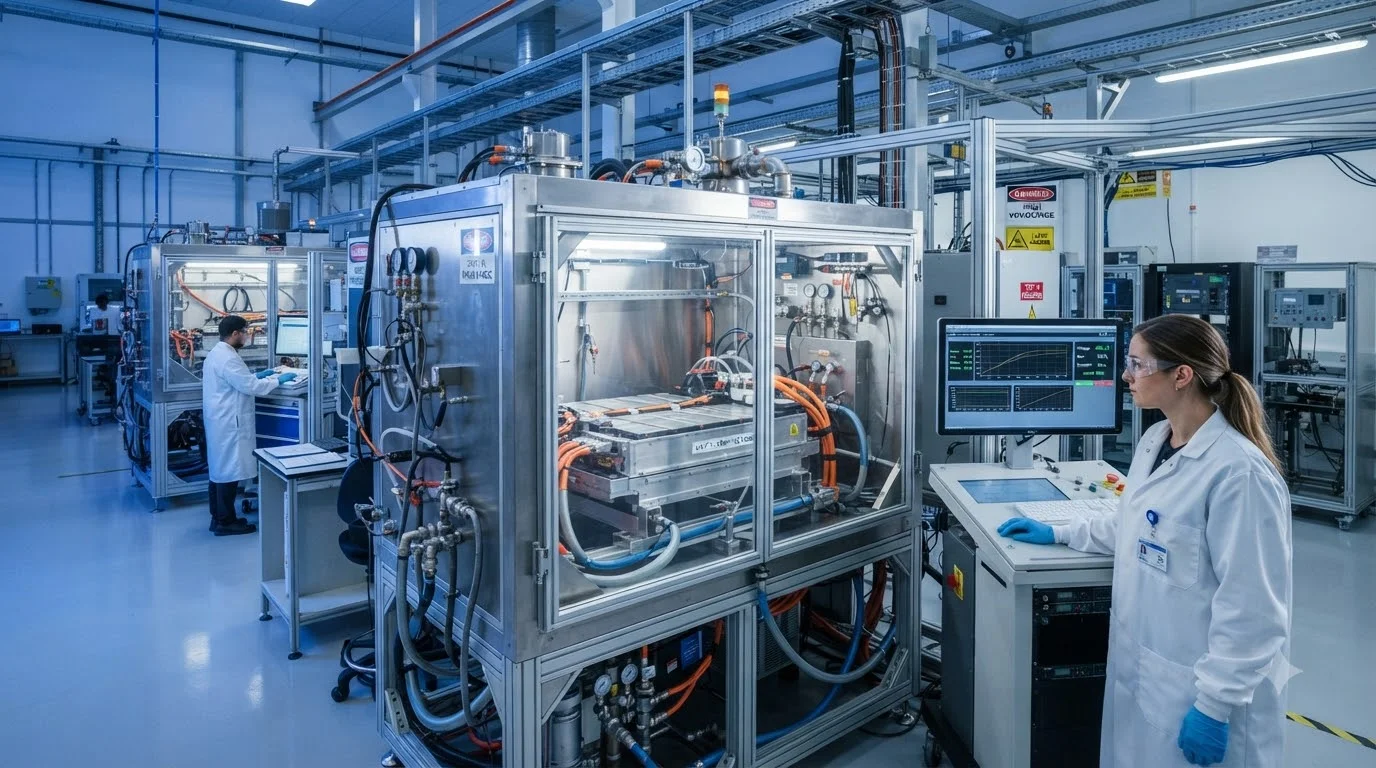
Electric vehicle battery packs don't fail in the lab. They fail on a highway in Rajasthan at 48°C, or in a Himalayan supply depot at -20°C after three years of humidity cycling nobody accounted for. That gap — between clean lab data and real-world climatic abuse — is exactly what BioGene's ISAT (Intensified Standard Alternating Trial) Chamber is built to close.
Manufactured by Biotechnologies Inc., a DRDO SAMAR Level-3 certified environmental simulation company with over three decades of engineering experience, the ISAT chamber sits at the intersection of two worlds that rarely get discussed together: defence-grade climatic qualification and modern EV/battery validation. Here's a technical look at what the chamber does, how it's built, and which standards actually govern it.
ISAT stands for Intensified Standard Alternating Trial — a climatic test protocol originally developed for qualifying explosive-filled defence components, where failure isn't an inconvenience, it's catastrophic. The chamber cycles a test article through alternating extremes of temperature, humidity, and ambient condition — including forced condensation — combined with a periodic dry-heat phase that replicates tropical, desert-like exposure.
BioGene's production ISAT chamber has a working capacity of 7,200 litres, large enough to accommodate full sub-assemblies rather than isolated cells or coupons, and supports two recognized trial variants:
Running both variants lets engineers separate two failure modes that often get conflated in simpler test regimes: moisture ingress/corrosion failures versus pure thermal-cycling fatigue.
Munitions engineers adopted ISAT because they needed proof that a component's performance and shelf life wouldn't degrade after years of uncontrolled climatic exposure. Battery packs face an almost identical reliability question — a cell or module that passes a single-cycle thermal shock test can still fail after eighteen months of real-world humidity-condensation-heat cycling in the field. ISAT's alternating-trial methodology gives EV and energy-storage manufacturers a way to compress years of field exposure into weeks of chamber time, surfacing:
A chamber that runs weeks-long alternating cycles has to survive its own test regime without becoming the failure point. BioGene's construction reflects that:
For dedicated EV/battery-focused chamber configurations, BioGene also builds in explosion-proof construction options, non-sparking fan blades, reinforced floors rated for pack-level loads, and LN2 surface-cooling provisions to help arrest thermal excursions during abuse testing — features that matter once you're cycling live lithium-ion packs rather than passive components.
It's worth being precise here, because "MIL CE standards" gets used loosely in the industry and the two frameworks serve very different purposes:
MIL-STD-810 (G/H revisions) is a US military test-method standard defining how to environmentally stress-test equipment — thermal shock, humidity, altitude, vibration, sand and dust, and so on. It's a testing methodology standard, not a product certification.
CE marking is a regulatory conformity mark required for equipment sold in the European Economic Area, covering directives like the Low Voltage Directive and EMC Directive. It certifies the chamber itself is safe and compliant to sell and operate — it doesn't certify battery performance.
BioGene's chambers are built to MIL-STD-810G/H test methodology and carry CE, ISO, JIS, and BIS compliance, with the manufacturing facility holding DRDO SAMAR Level-3 certification for defence manufacturing excellence.
For the batteries and packs actually being tested inside these chambers, the relevant standards are a different, battery-specific set:
| Standard | Scope |
|---|---|
| UN 38.3 | Transport safety testing for lithium batteries |
| IEC 62133 / IEC 62619 | Safety requirements for portable and industrial lithium cells/batteries |
| SAE J2464 | Abuse testing for EV and hybrid propulsion battery systems |
| UL 2580 | Batteries for use in electric vehicles |
| GB/T 31485 / GB/T 31467 | Chinese national standards for EV traction battery safety and cycle life |
| IS 16046 | Indian standard for secondary lithium cells and batteries |
| ISO 12405 | Test specifications for lithium-ion traction battery packs and systems |
A chamber built to MIL-STD-810/CE gives you a qualified, safe, repeatable environment. The battery standards above define what you actually do inside it. Conflating the two is a common but important mistake when specifying a test program.
In practice, an ISAT chamber complements rather than replaces dedicated battery-abuse chambers. A typical validation sequence looks like:
The ISAT chamber's role is specifically that third stage: proving durability against the slow, cumulative climatic stress that shorter single-parameter tests can't reveal.
BioGene's ISAT chamber brings a defence-grade, decades-proven climatic stress methodology to a problem the EV and energy-storage industry is still catching up on — proving that a battery pack survives not just one bad day, but years of alternating heat, humidity, and condensation. Built on MIL-STD-810G/H test methodology, CE-compliant construction, and backed by DRDO SAMAR Level-3 manufacturing certification, it's a chamber designed for the kind of reliability question that only surfaces after the warranty period starts.